Projects and Research
Analytical Fundamentals of Digital Image Correlation for agile tire dynamics
CHSLT Lab, U.S. Army GVSC and ARC sponsored
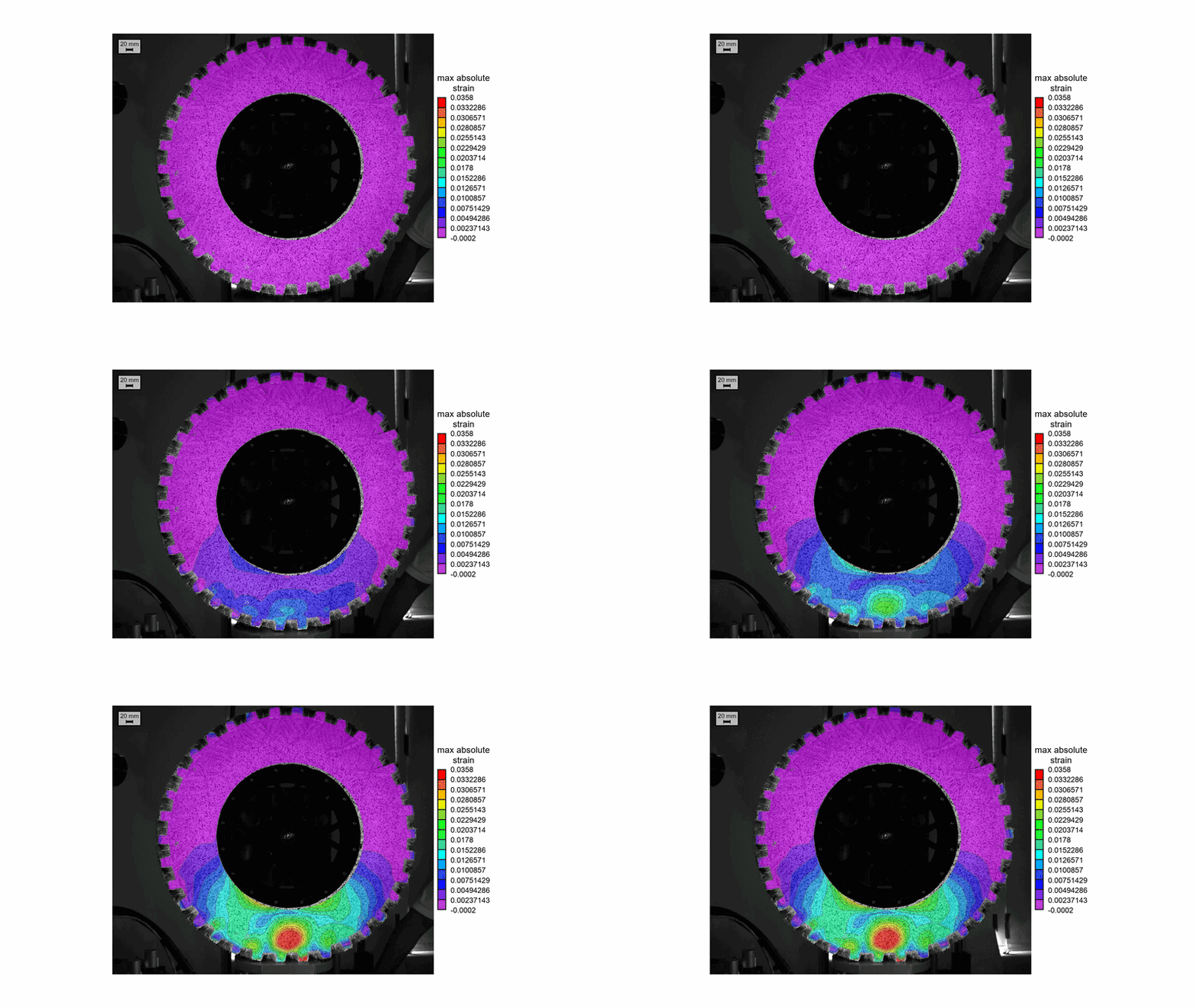
Agile tire dynamics, such as slippage and relaxation, are vital performance metrics for the safety and efficiency of autonomous vehicles. However, current experimental methods lack the full-field spatial and temporal resolution required to capture high-speed transient phenomena. To address this, I integrated novel 3D Digital Image Correlation (3D-DIC) with hyper-elastic FEA models, designing custom optical fixtures to quantify complex tire deformations during transient and steady-state conditions.
Currently, I am driving a U.S. Army-sponsored test campaign at GCAPS (Virginia Tech) to characterize mechanical properties under dynamic loads—specifically capturing slip angles, relaxation times, and instantaneous rolling radius. This experimental data directly feeds our computational models to improve real-time traction control. I regularly present these findings to U.S. Army DEVCOM GVSC and ARC sponsors, successfully contributing to continued project funding.
3D Laser Doppler Vibrometry for Structural Dynamics of UAV Components
Polytec Inc.
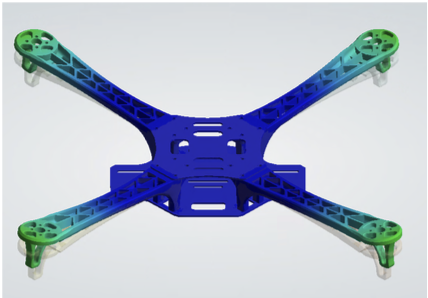
Ensuring the structural integrity and flight stability of commercial UAVs requires rigorous vibrational testing to prevent resonance-induced failures. To address this, I conducted comprehensive modal and vibrational analysis on a commercial drone frame using advanced 3D Scanning Laser Doppler Vibrometry (SLDV). By accurately mapping the frame's dynamic response, I identified critical resonant modes and operational deflection shapes, generating a highly accurate Frequency Response Function (FRF) dataset.
To validate the empirical SLDV findings, I correlated the experimental data with predictive Finite Element Analysis (FEA) models, ensuring the structural dynamics were fully characterized. I then delivered a comprehensive presentation to the Polytec applications team, demonstrating the complete workflow from physical setup and measurement to data analysis and FEA validation. Additionally, I executed high-precision surface profile measurements utilizing the ProSurf 3D optical profilometer to support specialized customer training.
Modal and Vibrational Analysis of 3D printed Airfoils
WPI
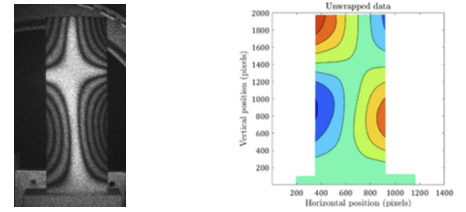
Lightweight aerospace structures, such as airfoils, require precise dynamic characterization to prevent structural failure and flutter under vibrational stress. To address this, I conducted advanced modal analysis on these complex geometries using Scanning Laser Doppler Vibrometry (SLDV) and lensless Digital Holography to generate accurate frequency response curves and identify critical resonant peaks.
To further analyze spatial mode shapes, I utilized digital holography, processing double-exposure holographic images into RTI files. I developed custom MATLAB workflows for full-field 3D deformation visualization and rigorously validated these empirical results against Finite Element Analysis (FEA) models. This integrated optical and computational approach successfully established a robust framework for improving the structural analysis and predictive modeling of lightweight aerospace designs.
Pneumatic Wearable Exoskeleton for Hand Rehabilitation
WPI
Post-stroke hand rehabilitation requires repetitive, task-specific training, but traditional rigid exoskeletons often cause patient discomfort and joint misalignment. To address this clinical need, I developed a pneumatically actuated, soft robotic wearable exoskeleton focused on delivering targeted, compliant assistance and natural joint articulation.
Instead of relying on rigid structural components, I designed and prototyped novel mechanisms that utilize stretchable, flexible materials, such as Thermoplastic Polyurethane (TPU). By carefully engineering the geometry and material properties of these soft actuators, I successfully translated pneumatic pressure into controlled, biomechanically accurate hand motions, optimizing the device for both patient safety and rehabilitation performance.